

Industrial Solar
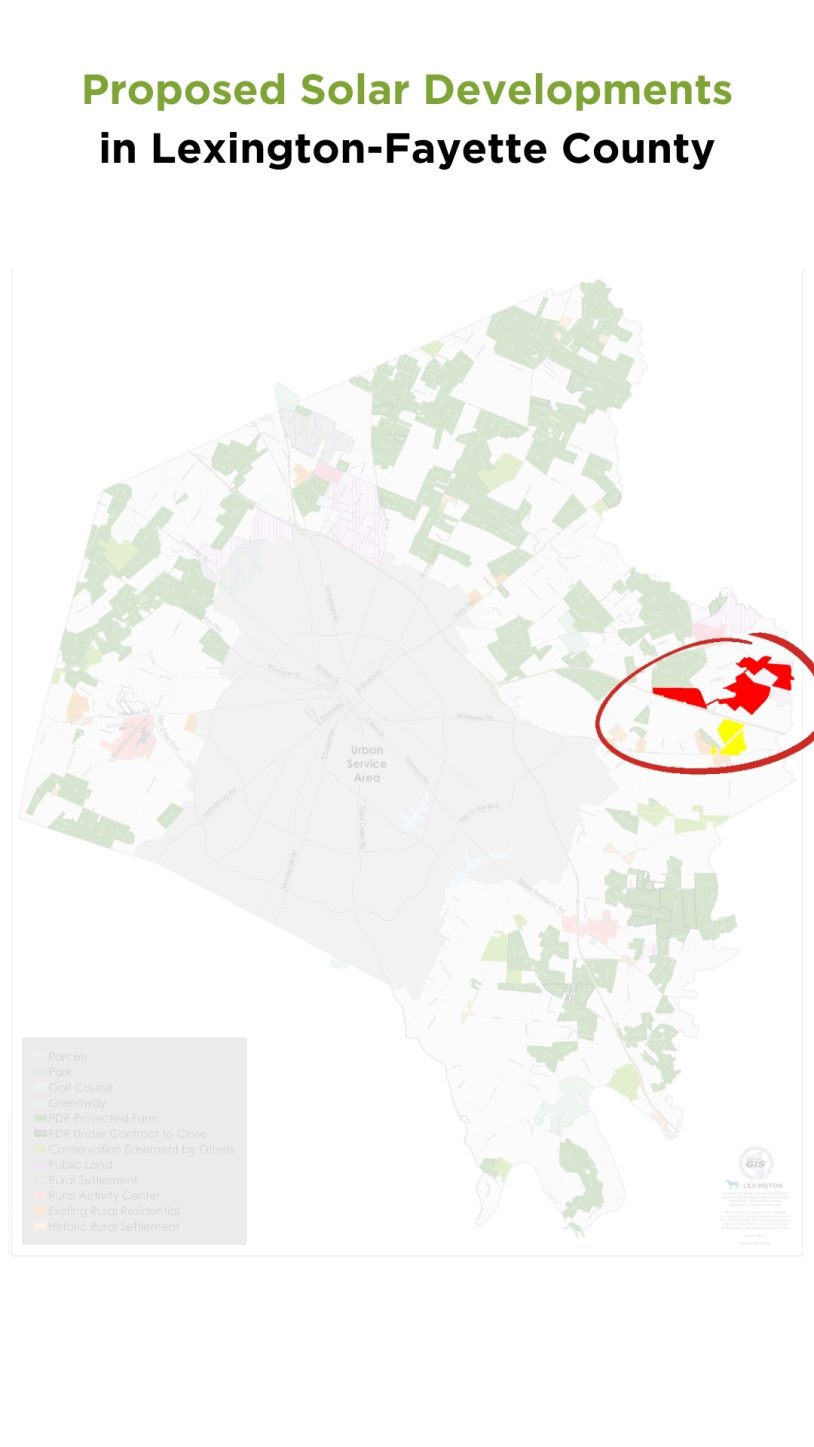
Silicon Ranch, a Nashville-based and privately-owned solar company, has proposed a Zoning Ordinance Text Amendment (ZOTA) that would permit industrial solar development throughout Lexington-Fayette County, including in the Agricultural-Rural zone.- Details: The ZOTA was proposed to accommodate an approximately 900-acre solar farm off Haley Road in the Agricultural-Rural zone, made up of multiple tracts of land.
- Need-to-know: This ZOTA change would apply county-wide, allowing for more developments of this type in the Agricultural-Rural zone.
- Fact: In 2018, Shell became the largest shareholder in Silicon Ranch.
View Silicon Ranch Project Photos

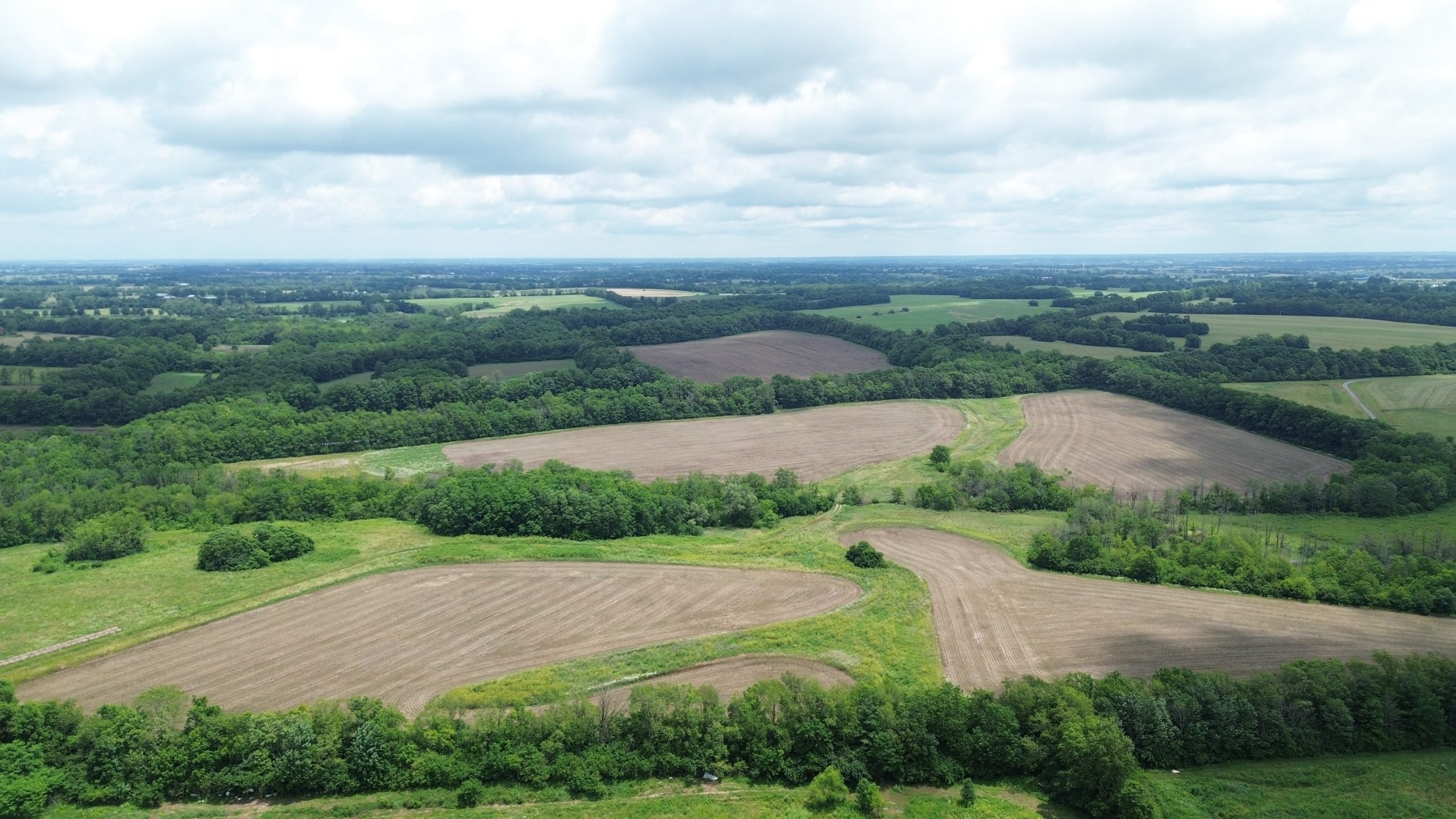
This is just a small portion of the 900 acres proposed for development. — Photo by Fayette Alliance

Newest Details
September, 2026
Mayor Gorton Vetoes Industrial Solar
On Friday, September 18, 2026, Mayor Linda Gorton vetoed the LFUCG Urban County Council’s proposed Zoning Ordinance Text Amendment (ZOTA) that, once finalized, would have allowed for the development of industrial-scale solar facilities on land zoned for agriculture in Lexington-Fayette County.
- Details: During her press conference, Mayor Gorton emphasized her continued support for solar projects, but expressed her deep concern for the precedent set by allowing industrial uses on farmland.
- Quote: “I know our Council worked very hard on this, and spent many hours discussing it, and I appreciate that. I’m sure they have the best intentions for our community,” Gorton said. “However, in their commendable desire to support solar projects, Councilmembers unfortunately set a gigantic precedent, opening the door to industrial use of our farmland.”
Mayor Gorton also discussed her administration’s ongoing efforts to support renewable energy projects in Lexington-Fayette County to help meet the city’s sustainability goals:
- The Haley Pike Landfill Project is a 357-acre industrial-scale solar facility being built on a closed landfill.
- The Solarize Lexington project is a city-led initiative designed to make rooftop solar easier and cheaper for homeowners and certain other property owners.
- The Gorton administration has spent approximately $2.7M on solar projects, which includes installing solar panels on fire stations and renovated government buildings.
The mayor’s choice to veto Council’s ZOTA is aligned with the opinion of both Planning Staff and the Planning Commission.
- Planning Staff have recommended against citing industrial-scale solar facilities on farmland twice in the past two years.
- Lexington’s Planning Commission has unanimously voted against the two recently proposed solar ZOTAs that would have allowed for industrial-scale solar development on farmland.
Processes and Next Steps
On Tuesday, August 18, 2026 the LFUCG Urban County Council voted 8-7 to adopt a zoning ordinance that would allow for the development of industrial-scale solar facilities on Agriculturally-zoned land in Lexington-Fayette County.
-
Council gave its second and final reading of this ordinance on Thursday, September 10, 2026.
-
According to the LFUCG Charter, the mayor has 10 days to either approve or veto the ordinance.
Now that the mayor has officially issued her veto on this Council-proposed ZOTA,
the Council can override the veto with a three-fifths vote of all Council members (9 votes total).
The ordiance adoption and veto process is listed out below: ⬇️
- An ordinance is adopted by Council.
- The Mayor reviews the ordinance and has 10 days to approve or veto.
- The mayor must return a vetoed ordinance to Council with a message explaining the reasons for the disapproval.
- The ordinance returns to Council and takes a vote to override the veto.
- Three fifths majority — or 9 votes total — are needed to override the mayor’s veto.
We will keep you updated on when this ZOTA will return to Council and provide further details on how you can advocate for responsible energy solutions for Lexington.
Here’s What We Think
Fayette Alliance is alligned with Mayor Linda Gorton, the City’s Planning Staff, and the Planning Commission on this issue.
- We do not believe industrial-scale solar facilities are a responsible use of our farmland.
It is imperative we find ways to mitigate our CO2 emissions at their source before we commit our farmland to industrial-scale solar development.
- The precedent set by allowing an industrial use in our rural areas undermines the goals and objectives of our Comprehensive Plan and places our farms at risk of future industrial development for years to come.
We agree with Mayor Linda Gorton when she said, “One of the most environmentally friendly things we can do in Lexington is protect our farmland from the threat of industrialization.”
August, 2026
On Tuesday, August 18, 2026, the LFUCG Urban County Council voted 8-7 to allow industrial-scale solar facilities as a conditional use in Agriculturally-zoned areas of Lexington-Fayette County.
- We believe this sets a dangerous precedent for our rural area moving forward, and opens the door for more industrial development on farmland in the years ahead.
The Council justified its decision in part by pointing to Lexington-Fayette County’s goal of becoming a net-zero energy community by 2045, as outlined in Lexington’s Comprehensive Plan.
- We share the same goal as this Council in wanting to reduce our community’s carbon emissions.
- However: We do not believe that opening up prime farmland to industrial-scale development — without a comprehensive plan for addressing emissions at their source — is a sustainable path toward achieving it.
Policy + Precedent
The policy adopted by Council allows industrial-scale solar facilities to occupy up to 1% of Fayette County’s total land area, nearly 2,000 acres.
- Question: But what happens when that 1% is met and we still have not reached our clean energy goal?
- There is no guarantee that future Councils will not face pressure to increase that limit. Also, public utilities are not subject to our local ordinance regulations or limitations and can continue to build solar development beyond this percentage cap.
And that is why we believe this decision matters far beyond the projects that will result from this week’s vote.
It establishes a precedent that future Councils will have to confront.
The Vote
The breakdown of the Councilmembers’ votes are listed below. ⬇️
Supporting solar development in Agricultural Zones: ✅
- Amy Beasley, District 8
- Emma Curtis, District 4
- Shayla Lynch, District 2
- Joseph Hale, District 7
- Tyler Morton, District 1
- Liz Sheehan, District 5
- Dave Sevigny, District 10
- Vice Mayor Dan Wu
Opposing solar development in Agricultural Zones: 🚫
- James Brown, Council at Large
- Chuck Ellinger, Council at Large
- Tom Eblen, District 3
- Lisa Higgins-Hord, District 6
- Whitney Baxter, District 9
- Jennifer Reynolds, District 11
- Hil Boone, District 12
You can click on each of the Councilmember’s names listed above to send them a personal email with your thoughts, or click the button below to email all Councilmembers simultaneously.

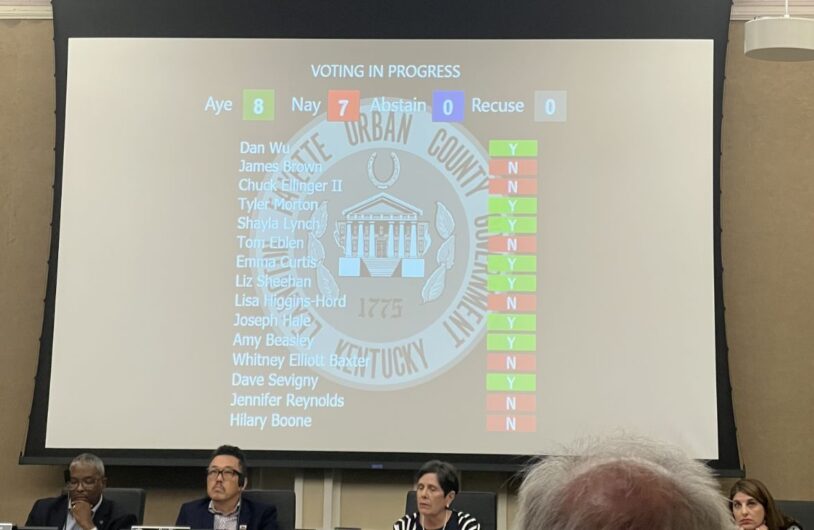
This photo shows the results of the final vote allowing industrial-scale solar facilities to be built on agriculturally-zoned land as a conditional use.
Public Comments
Fayette Alliance was present at City Hall during the vote for this new solar ZOTA. Executive Director, Brittany Roethemeier, and Marketing and Communications Director, Aaron Mikel, delivered public comment at the meeting.
- Watch their comments below. ⬇️
Timeline
The conversation around industrial-scale solar facilities has been ongoing at City Hall for over two years now. There have been multiple votes by different governing bodies both for and against the idea, making it difficult to follow the process:
Below, we’ve outlined exactly how this process has unfolded at City Hall. This Tuesday’s vote is a decision over two years in the making.
April 2024 | A Zoning Ordinance Text Amendment (ZOTA) was filed by private developer Silicon Ranch to accommodate an ~900-acre industrial-scale solar facility outside the Urban Service boundary on Agriculturally-zoned land.
September 2024 | Lexington’s Planning Commission votes unanimously against allowing industrial-scale solar facilities on Agriculturally-zoned land in Lexington-Fayette County.
September 2025 | The LFUCG Urban County Council adopts Lexington’s first solar ordinance, allowing small ground-mounted solar (up to 2,500 sqft.) as an accessory use in Ag zones, and allowing intermediate ground-mounted solar (up to 5 acres) in Ag zones as a conditional use. This vote also prohibited large-scale solar facilities (more than 5 acres) on Agriculturally-zoned land in Lexington-Fayette County. The Council also added a provision that serves as guidance to public utilities’ solar development in ag zones, which are not subject to local planning and zoning policies, which included an approximately 1,800 acre cap on solar on farmland. However, Council did vote to move the issue of large-scale solar facilities into a Work Group for further discussion.
October 2025-February 2026 | The Solar Work Group ultimately consisted of just four Councilmembers, and met over the course of five months to discuss industrial-scale solar facilities in ag zones further. These meetings were not open to the public, and representatives and organizations from Lexington’s agriculture community were not invited to participate in the Solar Work Group’s meetings, including Fayette Alliance, the Rural Land Management Board, Fayette County Farm Bureau, Bluegrass Land Conservancy, or farmers in Lexington-Fayette County.
April 2026 | The LFUCG Urban County Council reviewed the Solar Work Group’s new recommendations, which included allowing for industrial-scale solar development on Agriculturally-zoned land in Lexington-Fayette County. Council voted to advance these recommendations to the Planning Commission for consideration.
July 2026 | Lexington’s Planning Commission votes unanimously against the Solar Work Group’s recommendation of allowing industrial-scale solar facilities on Agriculturally-zoned land in Lexington-Fayette County.
August 2026 | The LFUCG Urban County Council will meet at a Council Work Session on Tuesday, August 18 at 3 p.m. to discuss and vote on a Zoning Ordinance Text Amendment (ZOTA) that, if approved, would allow for the development of industrial-scale solar energy systems on Agriculturally-zoned land in Lexington-Fayette County.
Position Statement
Read Our Solar Energy Systems Position Statement
About the Soil
-
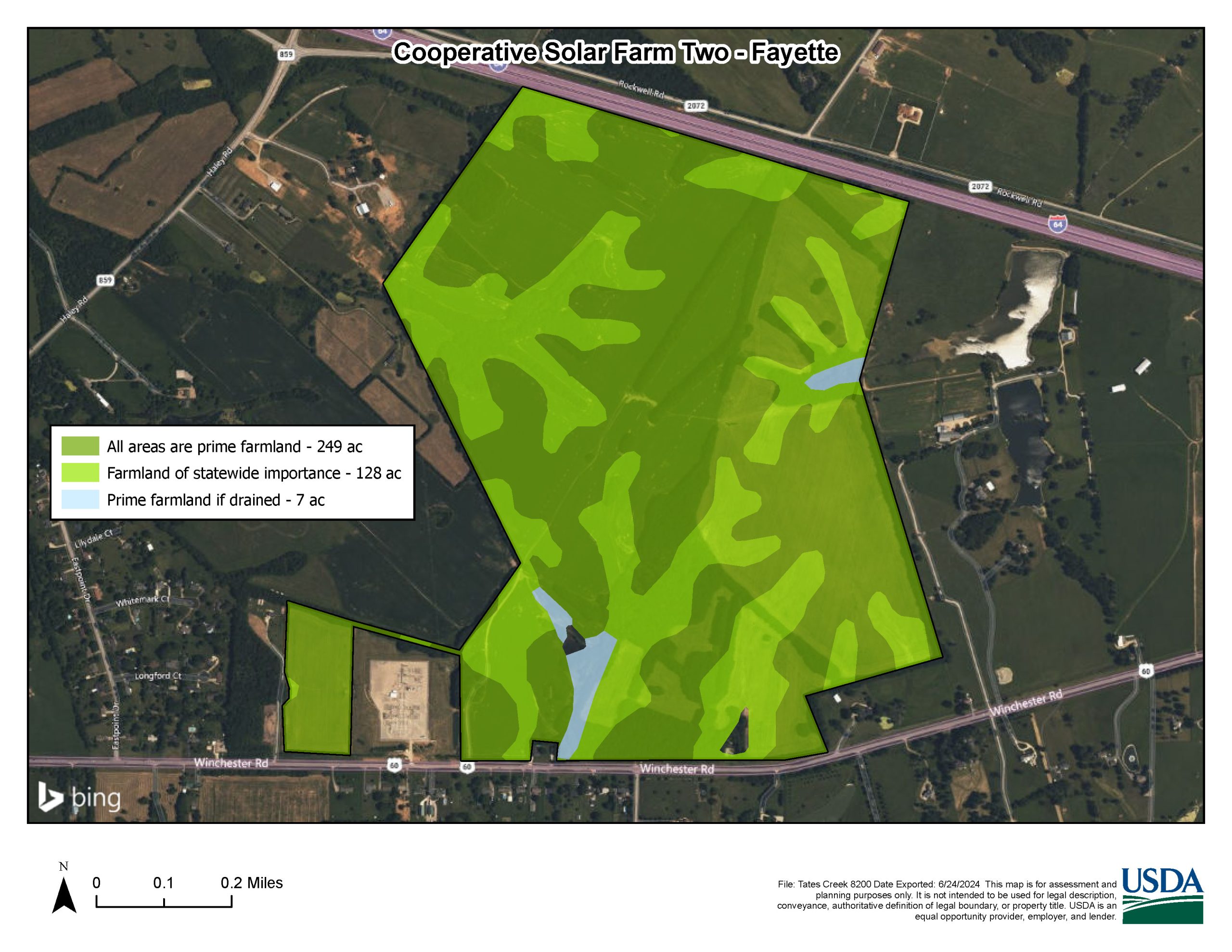
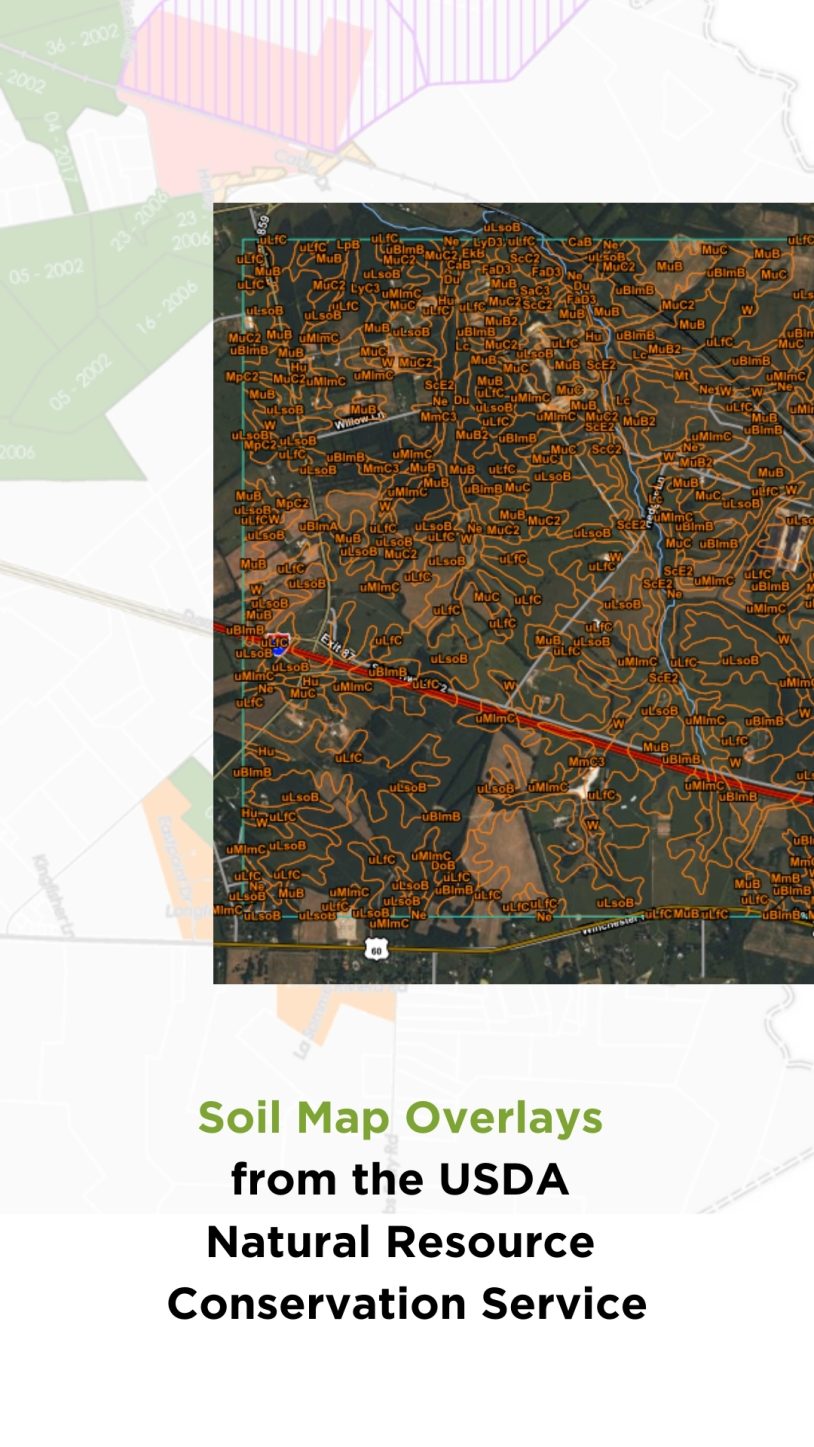
- Soil Map provided by USDA
-
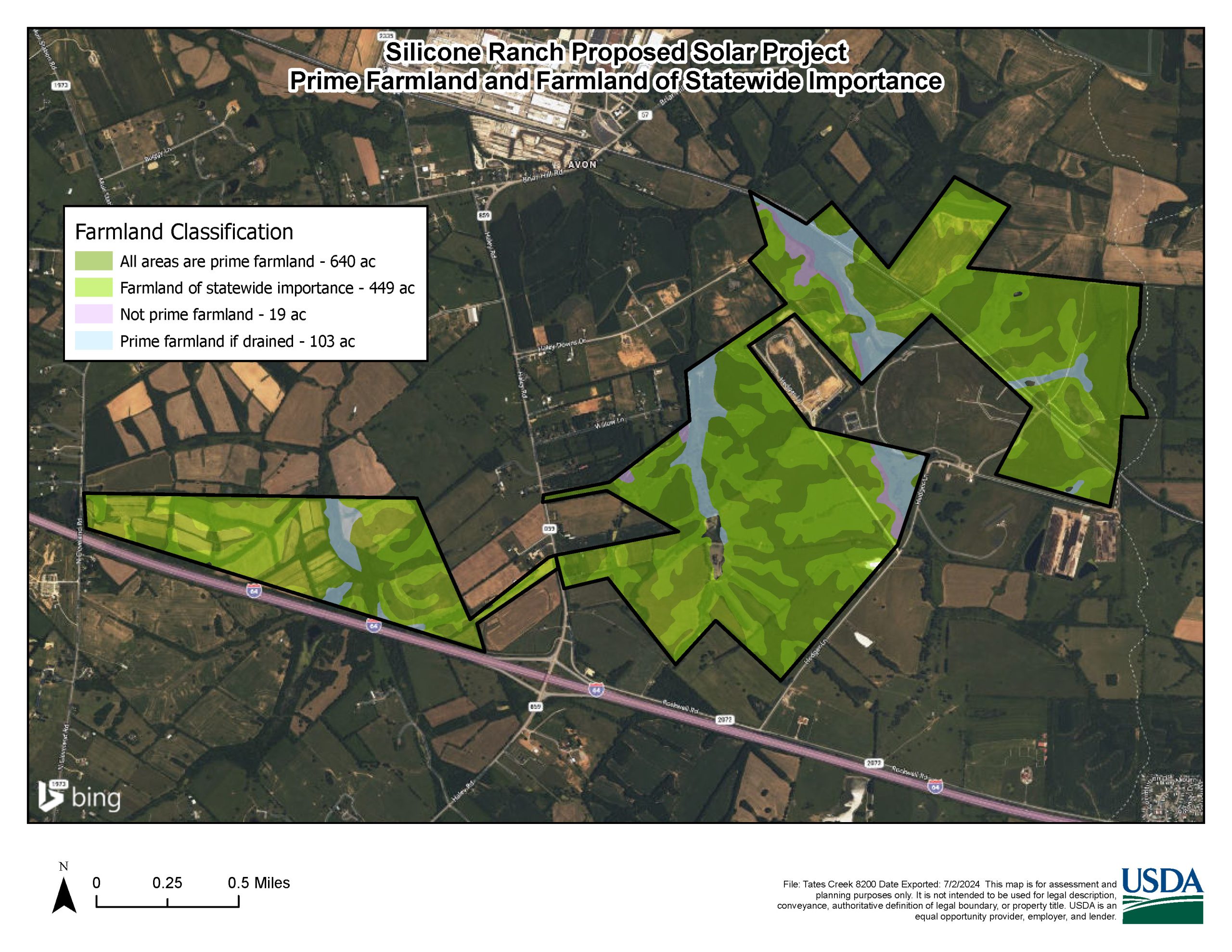
- Soil Map provided by USDA
The United States Department of Agriculture defines “Prime Farmland” as such:
“Land that has the best combination of physical and chemical characteristics for producing food. It has the combination of soil properties, growing season, and moisture supply needed to produce sustained high yields of crops economically if it is treated and managed according to acceptable farming methods.”
Using the USDA’s Web Soil Survey map, we attempted to determine approximately how much of the land proposed for solar development was categorized as “Prime Farmland.”
Process
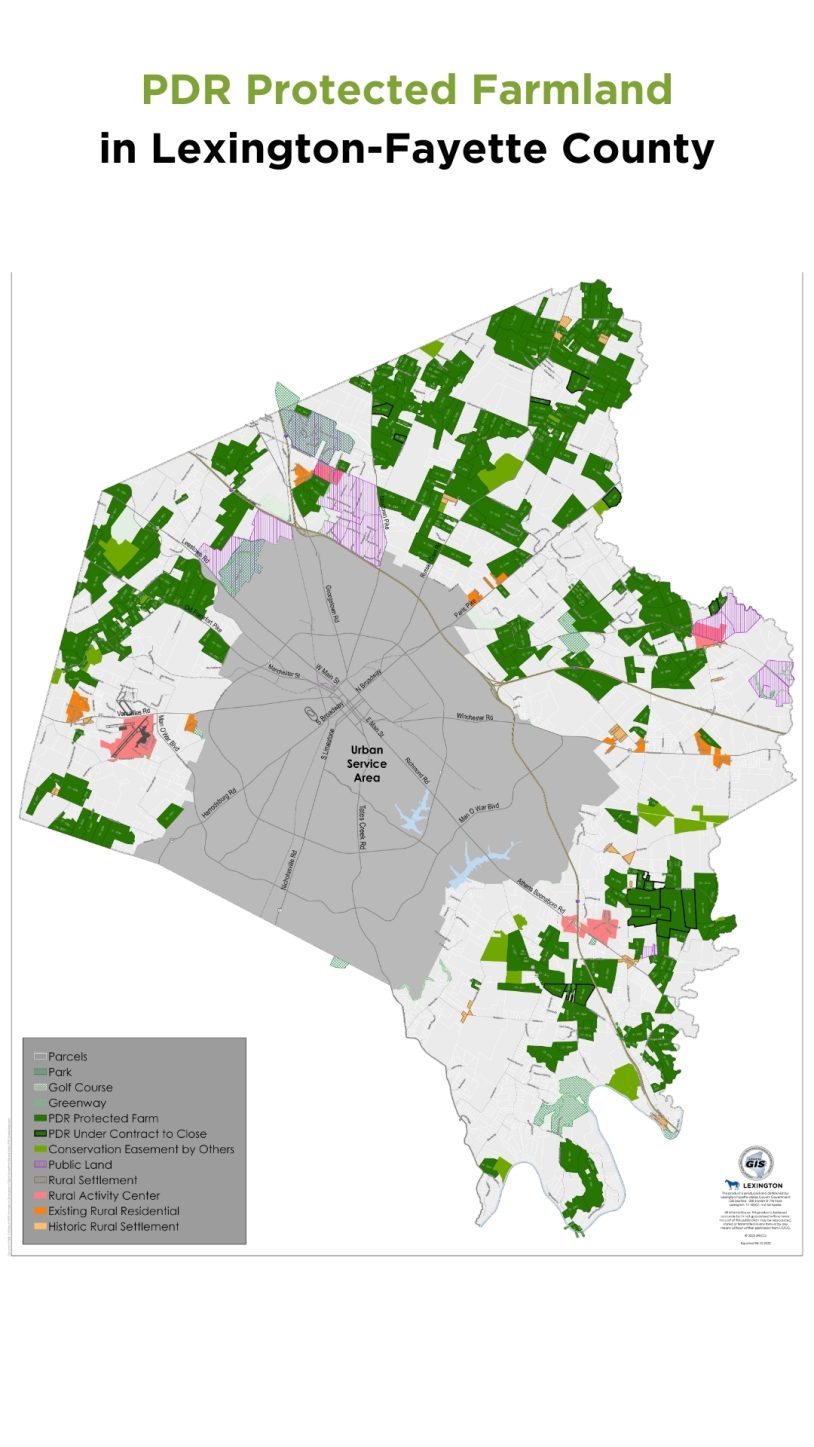
- We took a map of Lexington-Fayette County’s PDR-protected farms.
- We overlaid maps of the proposed solar development sites.
- We then used those maps to identify the soil quality of the proposed areas.
By our calculations, approximately 98.06% of the soil proposed for solar farming is considered “Prime Farmland” or of “statewide significance” by the United States Department of Agriculture.
- Need-to-know: None of the proposed acreage is used for equine operations.
- Consider: The soil that’s at risk is rich, fertile, and irreplaceable; capable of producing food for generations to come.
Full Details
We compiled our research and other soil-related information into short, easy-to-read PDF packets — one each for the proposed industrial solar projects. The studies include:
- maps of the proposed solar sites
- soil maps of the land proposed for development
- breakdowns of the soil types, including acreage and classification
- and more.
Click the buttons below to explore each soil study in detail.
Soil Study: East Kentucky Power Cooperative
Solar Spotlight
- Lexington, KY | The Locust Trace Agri-science Campus is a public school in Lexington-Fayette County specializing in the education of Agriculture Engineering, Animal Science, Equine Studies, Food Science, and Pre-Veterinary Studies. The 70,000-sqft. campus was designed to produce more energy than it consumes annually, making it a net-zero school within the Fayette County Public School system.
- Denver, CO | The Denver Public School (DPS) system is committed to reducing its overall greenhouse gas emissions by at least 90% of the emissions that existed in 2010 by 2050. DPS even has its own Sustainability Department to help achieve this goal. Solar panels have been installed on the rooftops of various DPS buildings throughout the city, and solar carports have been installed in parking lots. The carport panels were constructed in partnership with the City and County of Denver and will provide bill credits to DPS families who need relief on their energy bills.
- Arizona State University | ASU’s comprehensive solar program produces over 53MWdc of energy — enough to power approximately 30,000 single-family homes. The university utilizes both on-site and off-site solar installations to generate this energy. The on-site component of its solar initiative extends to four different campuses and the ASU Research Park, totaling approximately 80,000 solar panels.
- Rutgers University | Rutgers University has installed solar panels in 16 different parking lots across its facilities. These multifunctional installments generate approximately 3% of the university’s total energy consumption, and also provide much-needed shade to faculty, staff, and students in the summer months. Clemson University and Michigan State University have begun construction of similar projects on their campuses. complete a similar project on its campus.
- Santa Cruz, CA | This California city incentivizes its commercial businesses to invest in solar through rebates, free energy audits, and a city-wide Green Business Certification program.
- It’s important to note that Lexington incentivizes residential solar investment through its Solarize Lexington program. However, commercial businesses often have more land and square footage to accommodate solar infrastructure.
- San Antonio, TX | Last year, in September of 2023, the city of San Antonio, Texas allocated $30 million to construct solar panels on 42 different city-owned properties. Solar panels will be installed on rooftops, in parking lots, and in city parks to create shade canopies for residents. In total, this project will offset an estimated 11% of the City’s electricity consumption from its buildings.
- Evansville, IN | Evansville, Indiana Regional Airport has installed solar canopies throughout its parking. This solar installment is the Midwest’s largest airport solar canopy, and the second largest in the US. This initiative generates enough energy to offset 50% of the airport’s power.
- Ubiquitous Energy | This US-based company has invented a thin coating that turns windows into transparent solar panels. The company estimated that utilizing this new coating would be able to provide approximately 30% of a building’s energy needs.
- The Netherlands | In 2018, the Netherlands built solar bike paths spanning 1,000 square meters. These are not simply bike paths with solar panels placed alongside, rather, the paths themselves contain solar cells that are protected by a multilayer of resin, and the electrical architecture has been designed to reduce the amount of wiring.
- Belgium | A two-mile-long rail tunnel has been outfitted with 16,000 solar panels in Belgium, providing enough energy to power all of the trains in the country for one full day.
- India | The Cochin International Airport in India is the world’s first airport fully powered by solar energy, winning the “Champions of the Earth” award instituted by the United Nations in 2018. To achieve this, the airport utilizes 46,150 solar panels laid across 45 acres near its cargo complex.
Press and Media
Forward Kentucky | May 23, 2024
FOX56 | Solar Farm Info Session | July 9, 2024
WEKU | Solar Farm Info Session | July 9, 2024